Questions, answered
Half of these are about perimenopause, because the information gap is the original problem. The rest are about Perity — what it tracks, what stays on your phone, and who can see what. If your question isn't here, ask: hello@perity.app.
Perimenopause, straight answers
Am I too young for perimenopause?
Probably not. It typically starts in the 40s and sometimes in the late 30s. If your symptoms fit the pattern, they're worth evaluating regardless of age.
My periods are still regular — can this still be perimenopause?
Yes. Hormone swings cause symptoms years before cycles change noticeably. Regular periods don't rule it out.
Can a blood test confirm perimenopause?
Rarely, mid-transition — hormone levels swing so much that one reading proves little. The diagnosis is clinical: your age, your cycle pattern, your symptoms. That's why the record matters more than the lab slip.
Is brain fog a real symptom?
Yes — cognitive changes are among the most commonly reported symptoms of the transition. It's a recognized symptom cluster, not something you're imagining.
Why am I suddenly anxious or furious?
New-onset anxiety, irritability, and rage are well documented in perimenopause, often tracking progesterone's decline and estrogen's swings. Log when they happen — the cycle-phase pattern is useful evidence.
Is HRT safe?
For most healthy women under 60 or within 10 years of menopause onset, the position of the major menopause societies — The Menopause Society's 2022 hormone-therapy statement among them — is that benefits outweigh risks. And the delivery route changes the risk picture. Whether it's right for you is a conversation with your clinician.
What's the difference between HRT and MHT?
Nothing — MHT (menopausal hormone therapy) is the newer clinical name for HRT.
I was told estrogen causes blood clots. Is that true?
The clot risk is a property of oral estrogen's pass through the liver. Transdermal estrogen — patch, gel, spray — is not associated with increased clot risk in large studies. For why so much of what you've heard comes from studies that weren't about women like you, read The trials that never included us.
What should I bring to my first appointment?
A dated symptom record, your cycle history, your med and supplement list, and family history written down. Book a problem visit, not the annual exam.
Which labs should I ask for?
Advanced lipids (ApoB, Lp(a)), fasting glucose and insulin with HOMA-IR, a baseline DEXA plus vitamin D, thyroid, ferritin, and hsCRP. Each one catches something different, and Perity's built-in Learn library explains what.
How Perity works
What does Perity actually track?
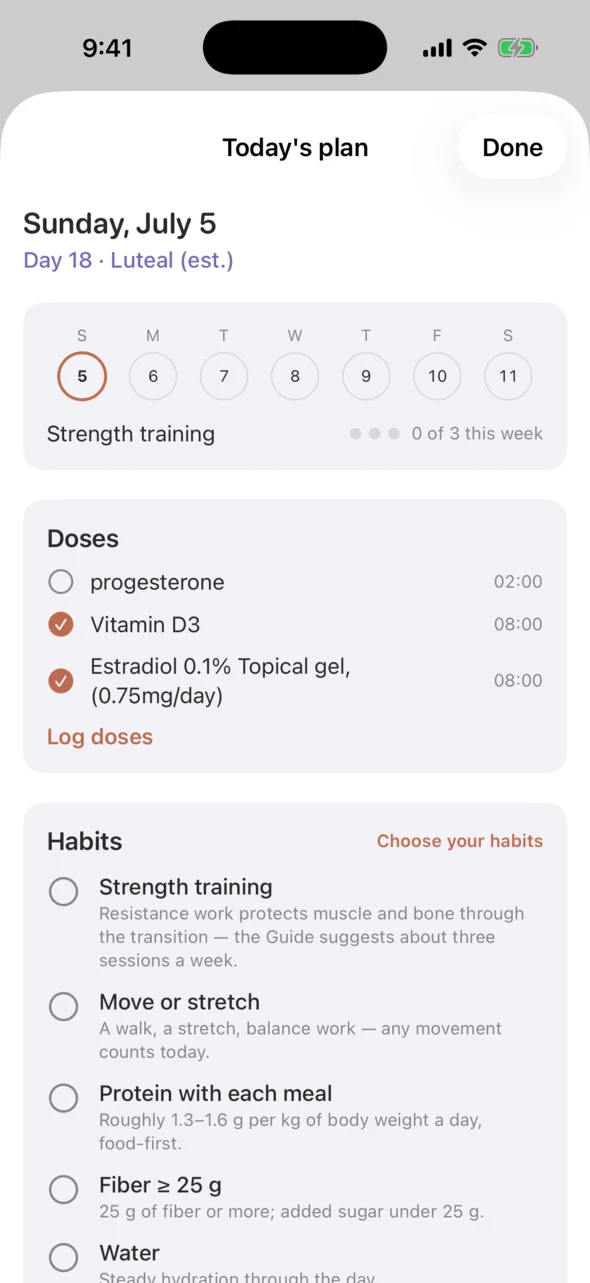
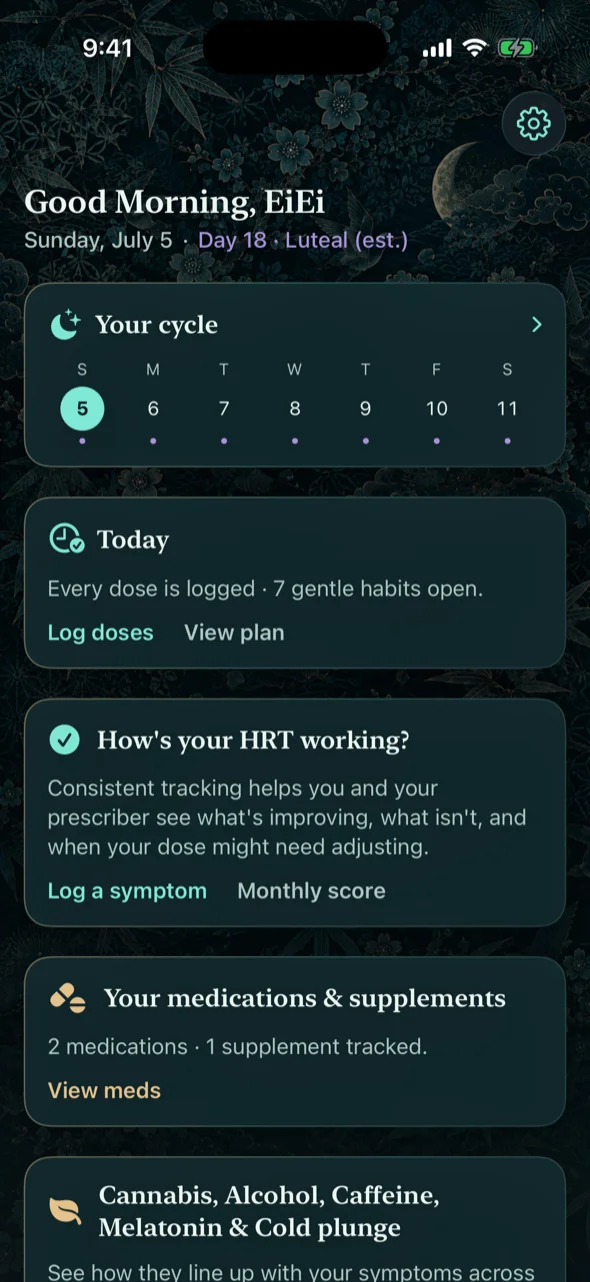
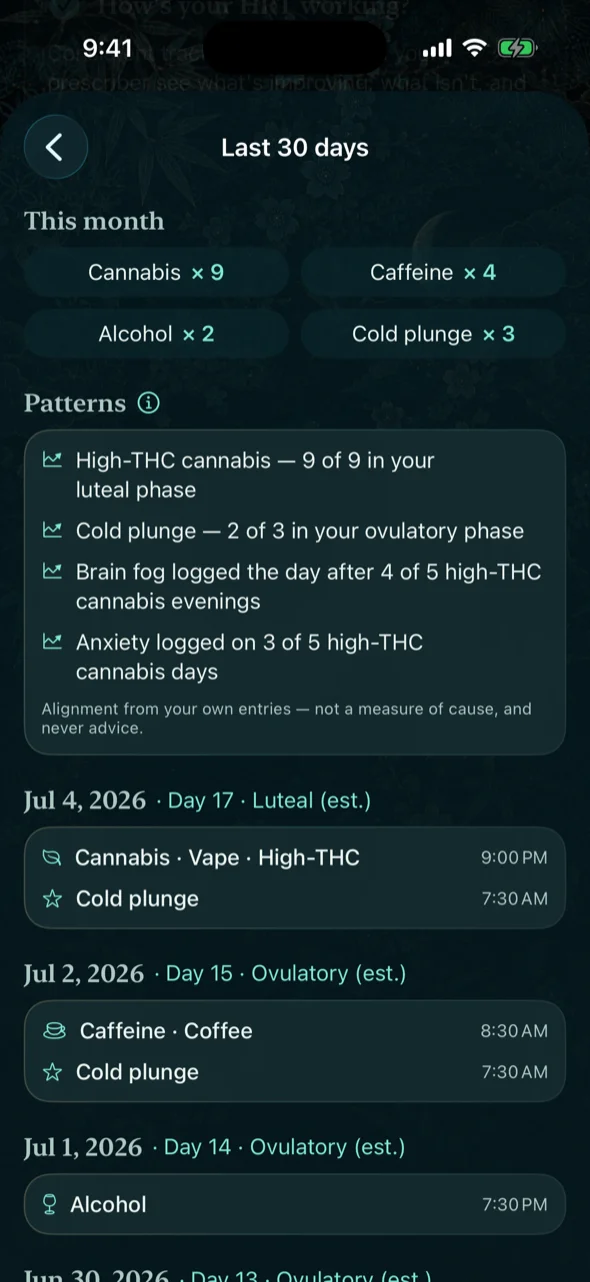
Symptoms (22 curated ones, from hot flashes to rage to frozen shoulder), HRT and medication schedules — patch rotation, gel dosing, cyclic progesterone — supplements, sleep and cycle data from Apple Health, labs including Mira wand readings, caffeine, alcohol, cannabis, and anything you define yourself. Notes can be typed or dictated.
Do I need a diagnosis to use Perity?
No. Most people start tracking before anyone has said the word perimenopause out loud. That's the point — the record you build is the baseline that makes the eventual conversation faster and harder to dismiss.
Where does my wearable data go, and where do the patterns get computed?
Perity reads your wearable data from Apple Health on your phone and reduces it to daily summaries — hours slept, night wake-ups, steps, heart trends. Those summaries sync to the same encrypted, nickname-keyed clinical record as everything else you log, because the patterns that matter most are slow: sleep that shortens over months, steps that decline for a year before anyone connects the dots. Long-horizon trends are computed by Perity over your own record — and only yours. The raw stream — every heartbeat, every sleep stage — stays on your phone, and the same-day nudges on your Home screen are computed on-device.
Either way, what you see is alignment from your own data — not a measure of cause, and never advice.
Do voice notes get uploaded somewhere for transcription?
No. Dictation uses Apple's on-device speech recognition with the on-device-only flag set — there is no server fallback in the code. If your iPhone can't transcribe locally, the mic tells you so instead of quietly uploading. Audio is never saved as a file and never leaves your phone; only the text you keep becomes part of your note.
Can I track something Perity didn't think of?
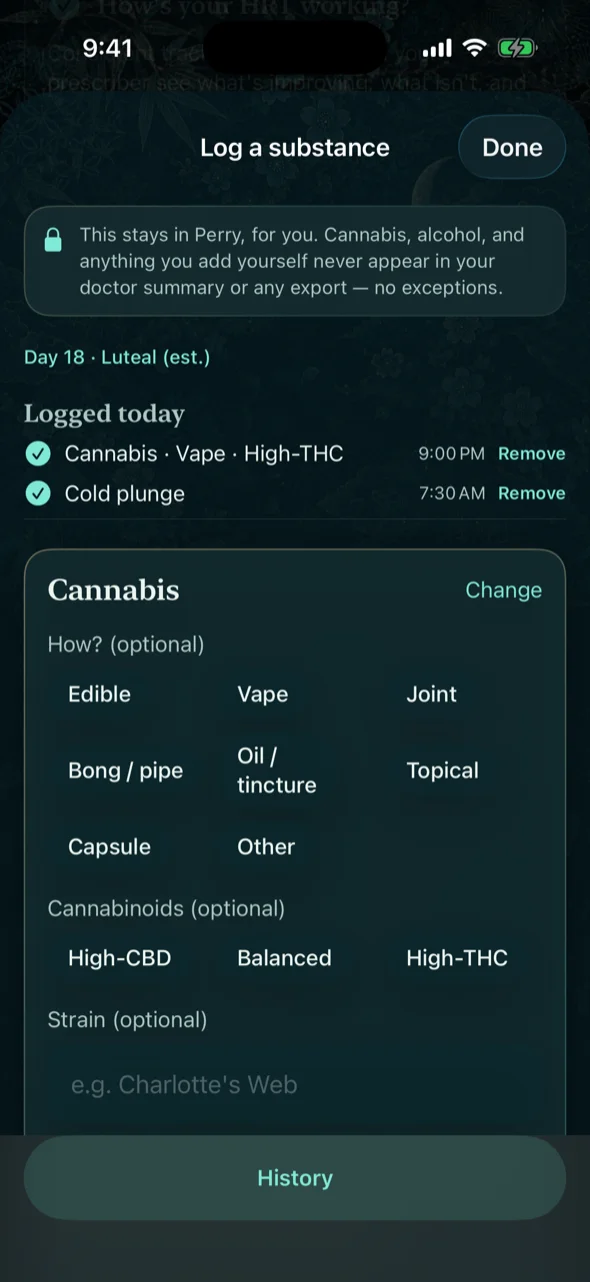
Yes — add your own trackables, up to twelve: tart cherry juice, cold plunges, gluten, whatever you're testing. The list of what you track is itself sensitive, so custom names are stored only on your device. And customs follow the same rule as cannabis and alcohol: never in your doctor report.
I use a Mira wand. Does Perity read it?
Yes. Export the PDF report from the Mira app and Perity parses it on your phone — LH, FSH, E3G, and PdG readings land in your labs with cycle context, including the censored values (that “> 30” reading) handled correctly.
Which wearables work with Perity?
Apple Watch, Oura, Whoop — anything that writes to Apple Health. Perity reads only the categories you approve (sleep, steps, cycle history, heart rate and HRV, temperature), and you can revoke access in iOS Settings at any time. Your phone reduces the raw stream to daily summaries and syncs those to your own encrypted record so Perity can watch the long game — the raw stream itself never leaves the device. The Android build in development will work the same way through Health Connect, including Samsung and Google health data.
What's the doctor report?
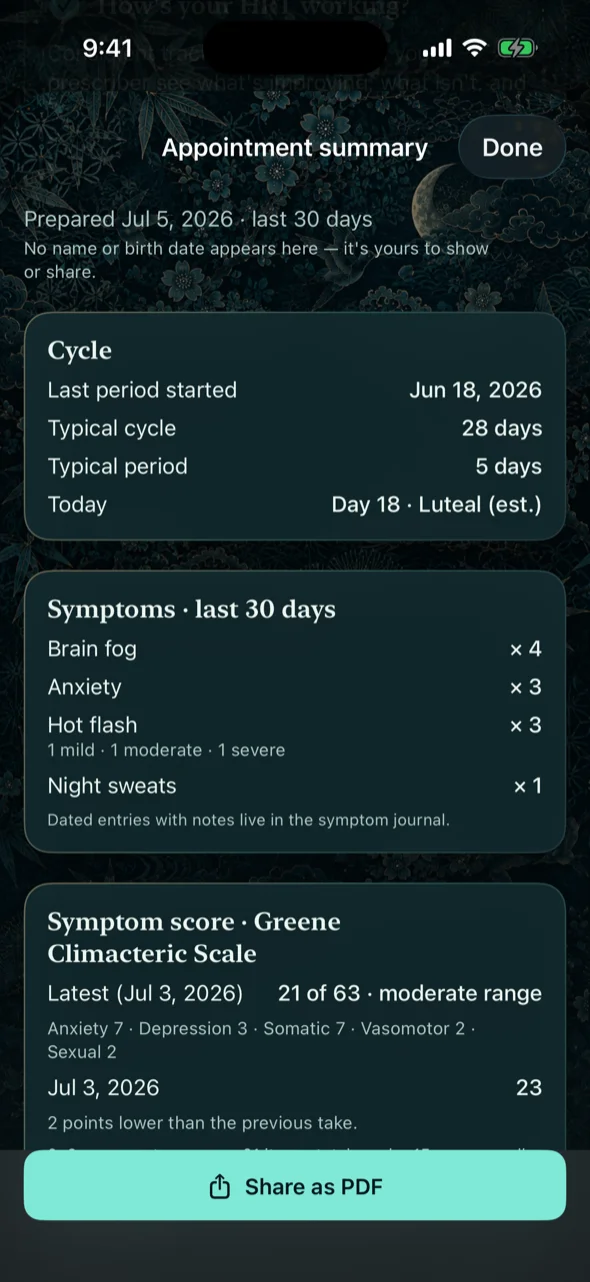
A 30-day appointment summary built to be handed across a desk: symptom counts with severities, your cycle picture and today's phase, a validated symptom score, current medications with dose adherence, and your latest labs. It has no name and no date of birth anywhere on it — de-identified by design.
Is Perity medical advice?
No. Perity informs, never prescribes — decisions belong with you and your clinician. The app says so on every screen where it could possibly be misread, and it means it.
When can I get it? What about Android?
Perity is in private beta on iPhone; the waitlist is the way in. An Android build is in development.
Privacy, in plain terms
Why doesn't Perity ask for my real name?
Because it doesn't need it — and in 2026, reproductive health data with a legal name attached is a liability you shouldn't have to carry. You sign in with Apple (private relay welcome), pick a nickname, and Perity keeps clinical records structurally separated from identity. The receipts are in Why Perity does not need your real name.
I log wine and weed. Will my doctor see that?
No. Never. Cannabis, alcohol, and anything you add yourself never appear in the doctor report, or in anything Perity prepares for you to share with a clinician. This isn't a settings toggle you have to remember to flip: those reports are built from queries that structurally cannot see the journal, and entries are never coded with the clinical “substance use” labels that follow people around health systems. The only copy that includes them is your own full data export — everything Perity holds, handed to you and no one else.
You're an adult. You might be medicating. You might live somewhere it's fully legal. That context belongs to you, not your chart. Caffeine is the one exception — it may appear in a report where it's clinically useful — and Perity tells you which side of the line everything sits on at the moment you log it.
Who can actually see my data?
You. Records are keyed to your account, not your name, in the same kind of clinical infrastructure hospitals use (FHIR R4, encrypted in transit and at rest, covered by a healthcare data agreement). There is no dashboard where anyone browses symptoms. Getting to your health data takes your sign-in on your device, then a Face ID gate — on by default — before anything renders. The full policy is at perity.app/privacy.
What stays on my phone, and what leaves it?
Stays on your phone: your tracker set-up (the standing list of which substances and custom things you track is never stored server-side), voice-note audio, the raw wearable stream, and the entire Learn library (it ships inside the app and makes no network calls). Leaves your phone, encrypted, to your own clinical record and nowhere else: the entries you choose to log — symptoms, doses, cycle dates, habit ticks, substance and custom entries, lab readings you import, notes — plus daily health summaries (sleep, wake-ups, steps, workouts, energy, heart trends) if you connect Apple Health, so your trends survive a lost phone and reach your doctor report.
Will Perity put medication names on my lock screen?
No. Reminders are scheduled on your phone — never pushed from a server — and worded generically on purpose. What you take is your business, not your lock screen's.
Can I get my data out?
Yes. Perity stores clinical data as FHIR R4 — the open standard hospitals use — precisely so your story stays portable and readable outside Perity. The doctor report is the first export; more export shapes are coming.
Perity informs, never prescribes — decisions belong with you and your clinician.
Still curious? Join the waitlist or write to hello@perity.app — you'll get the founder, not a form letter.